

Rituals
Yarqa Aspiy
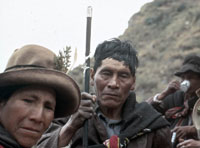
Varayoq at Qonopa (ISB_00297)
The Yarqa Aspiy, the ritual cleaning of the irrigation canals, is observed in September. It signals the beginning of the rainy season and subsequently planting. The ritual is preceded by three days of communal labor, the actual cleaning of the dual irrigation system. Ritual payments are made at each irrigation canal to the Wamanis and to Pachamama (mountain deities and Earth Mother) to ensure rain and good harvests.
Yapuy
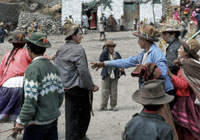
Yapuy, Cancha Cancha (ISB_00186)
Also known as Chacra Yapuy, literally "to plant the field," this ritual first planting of the agricultural year is takes place late in August in the community of Cancha-Cancha, near Chuschi. In Chuschi itself, the first corn planting is observed in September in connection with the Yarqa Aspiy.
Many Chuschinos and other neighboring villagers attend this important corn ritual in Cancha-Cancha. It is also a rite of sexual reversals. A man dressed as a woman, with blackened face, "plants" the plaza instead of a field representing a reverse portrayal of actual planting. The man who is portraying a woman's role in planting uses as seed the leftovers at the end of the chicha-making process, corn which is fermented and therefore sterile.
A short discussion of Yapuy appears in To Defend Ourselves, Ecology and Ritual in an Andean Village, by Billie Jean Isbell. Waveland Press, 1985, chapter 9 section 3.
Corpus Christi
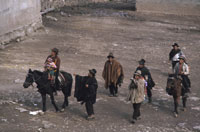
Corpus Christi celebrants (ISB_00249)
The dual opposition of civilized versus savage is dramatized during Corpus Christi in late May or early June, before the June solstice. Sallqaruna, or "savage men" from the puna descend to the village on horseback and enact savagery by defiling the Virgin Mary and insulting everyone they meet.
Navidad
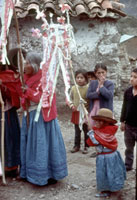
Navidad participants (ISB_00225)
Navidad, the December solstice ritual, is a fertility rite for llamas, performed in the village center by one of the prestige hierarchies of the village. It expresses the mutual interdependence of animal and human fertility. The rite is performed by a group of female dancers who dance in a large U shape, and one male dancer, in costume with a llama skin over his head, repeatedly enters the U configuration of the women, as a symbolic act of copulation. See To Defend Ourselves, Ecology and Ritual in an Andean Village, Waveland Press, 1985, chapter 9 section 2.
Santa Cruz
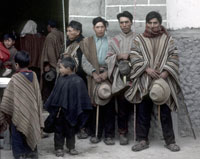
3 de mayo (ISB_00226)
Literally meaning "Holy Cross," this Feast of the Crosses observes the harvest and the beginning of the dry season. It occurs on the first three days of May. Two major activities occupy the villagers: all of the crosses are decorated with produce from the ecological zone where they are grown and brought into the village, and, a new taksa varayoq (literally, lesser bearer of the staff) is installed for each of the two barrios in the village.
Images of this ritual are from slides taken by Billie Jean Isbell during the 1967 observation of the Santa Cruz at Chuschi, Peru. For a detailed description of this ritual, see her ethnology, To Defend Ourselves, Ecology and Ritual in an Andean Village, Waveland Press, 1985, chapter 6 section 3.
Funeral rituals
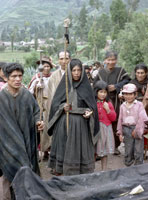
Funeral (ISB_00357)
Funerals were the first rituals in Chuschi that Isbell was allowed to attend in 1967 (see the introduction of To Defend Ourselves, Ecology and Ritual in an Andean Village, Waveland Press, 1985 as well as, chapter 5 section 7. A funeral ritualizes, not only the loss of a family member, their burial and subsequent journey to the world of the dead, it also symbolizes the restructuring of the kindred. The fear of the dead remaining within the community of the living and causing harm motivates the required ritual observances for one year after the death and burial.
Llama sacrifice
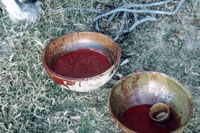
Llama sacrifice for June Solstice (ISB_00890)
This llama sacrifice was photographed in 1990 during the Cornell summer program in Cochabamba, Bolivia. It was a ritual organized by urbanites (mostly Quechua speakers) from the city during the June Solstice. They paid two Aymara ritual specialists (Yatiri) from the altiplano to perform the sacrifice to Tayta Inti, the Sun. The ritual took place on a hill on the outskirts of the city of Cochabamba with a good view of the eastern horizon in order to observe the rising of the sun. The Yatiri also sold herbal remedies during the ritual.
Herranza
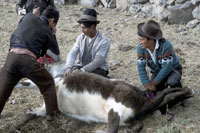
Huanca Sancos Herranza (ISB_00171)
Herranza is a fertility rite involving branding cattle and sheep accompanied by ritual offerings to the Wamanis (or Huamanis), powerful deities associated with local mountains or lakes. Wamanis are characterized as both benevolent and malevolent, and their moods are capricious. Ritual payments to them are prescribed carefully. Failure to observe the proper formula for payment can lead to death to the herds and members of the family. The cattle Herranza takes place during the dry season in August, and the sheep Herranza during the wet season in February. Herranzas are observed by both individual households and the community as a whole. If the Herranza has been carefully prepared and properly executed, the herds will increase and be protected by the Wamani.
There are two sets of images of the Herranza ritual in this collection, one showing details of a family Herranza, and the other a communal Herranza.
Bibliography:
Isbell, Billie Jean. To Defend Ourselves: Ecology and Ritual in an Andean
Village. Prospect Heights, Ill.: Waveland Press, 1985.
URL: http://hdl.handle.net/1813/2135